Located at mile marker 84.5 in Islamorada, Florida Keys
Open 365 days per year
Ticket counter opens 9:30 A.M.
TEL 305.664.2431
FAX 305.664.8162
Contact us


        about dolphins and sea lions
Marine Mammal Adventure!


Dolphins and sea lions are mammals and are therefore warm-blooded, breathe air, give birth to live young, nurse and care for their young, and have hair. Sea lions are covered in fur; dolphins have a mustache that falls out shortly after birth.
 
ATLANTIC BOTTLENOSE DOLPHINS Tursiops truncatus
Dolphins belong to a scientific order of marine mammals called Cetaceans.  The 2 types of Cetaceans are baleen whales and toothed whales. 
 
Baleen whales have 2 blowholes, have baleen plates instead of teeth, and include the larger whales such as the blue whale.
 
Toothed whales have 1 blowhole, have teeth, and include species such as the dolphin, porpoise, sperm whale, and pilot whale.
 
Dolphins and porpoises are often confused with one another but belong to 2 separate scientific families of toothed whales. Porpoises are smaller, darker, live in deeper and cooler water, do not have a pronounced beak or rostrum, and have spade shaped teeth. 
 
There are 36 species in the dolphin family. The following information applies to Atlantic bottlenose dolphin. 
 
Atlantic bottlenose dolphins inhabit temperate, coastal waters around the world.  They can live into their forties, can reach sizes up to 10 feet long and 600 pounds, and are active predators who feed on small, schooling fish.
 
Atlantic bottlenose dolphins reach sexual maturity between ages 5 to 12.  Females have a mammary slit on either side of the genital slit. Calves are born after a 12-month gestation, are 3 feet long and 30 pounds at birth, nurse for 2 to 4 years, and begin to eat fish at a few months of age.
 
The bottlenose or rostrum is actually the jawbones and is used to touch and push.  Their 88 cone shaped teeth are for grasping and tearing food, not chewing.
 
The blowhole on top of the dolphin’s head is a nose from which they breathe twice/minute.  They can hold their breath for 8 minutes.  Vocalizations are produced in the blowhole, not the throat.
 
The pectoral fins on the dolphin’s side are used for steering and have all of the bones of a land animal’s forelimbs.
 
The dorsal fin on the dolphin’s back is for balance and is made of a dense, fibrous connective tissue.
 
The peduncle is the muscular area that powers the flukes or tail.  Atlantic bottlenose dolphins can swim up to 17 miles/hour.
 
Atlantic bottlenose dolphins see well above and below the water, hear well, especially below the water, use echolocation to navigate and find prey, and have no sense of smell.
 
CALIFORNIA SEA LION  Zalophus californianus
Sea lions and their relatives, seals and walruses, belong to a scientific order of marine mammals called Pinnipeds.
 
Seals and sea lions are related but belong to separate scientific families and differ in a few ways. Sea lions have an external ear flap; a seal' external ear is a pinhole opening. Sea lions have much larger fore flippers than seals.  To propel themselves through the water, sea lions move their fore flippers in an up and down flying like motion; seals move their hind flippers in a side to side fish like motion. To move about on land, sea lions can walk on all four flippers; seals scoot around similar to an inchworm.
 
There are 5 species in the sea lion family.  The following information applies to the California sea lion.
 
California sea lions inhabit the temperate coastline and islands of the western Americas from British Columbia to Ecuador.  They spend time at sea and come ashore frequently to bask in the sun and sleep.  They are agile and maneuver well on land and in water.  They can live about 25 years and are active predators who feed on squid, octopus, and fish.
 
Males usually have a darker coat of fur than females and weigh up to 900 pounds, 3 times the weight of females. Breeding season is between May and August. Pups are born after a 12-month gestation, are 13 pounds at birth, and nurse up to a year.
 
Sea lions communicate with one another through vocalizations and postural displays.  They are tactile and seek out contact with other sea lions.
 
They usually stay submerged 3 minutes or less but can hold their breath up to 15 minutes. 
 
They have 34 to 38 teeth that are designed for grasping and tearing food, not chewing.
 
They have 25 whiskers to explore objects on land and water.
 
Their fore flippers have all of the bones of a land animal's forelimbs, but are modified for swimming at speeds of up to 23 miles per hour.
 
The hind limbs are used for steering and can be rotated underneath their body enabling them to walk on all fours.  Three nails on the hind flippers are used in grooming.  A small, flattened tail is located between the hind flippers.
 
California sea lions see well on land and in water and their large eyes are very light sensitive. Hearing is one of their most important senses.  They have a sense of smell and a poor sense of taste.
 
THEATER OF THE SEA ANIMAL CARE AND TRAINING
 
ANIMAL CARE PRICIPLES
The health and well being of the animals at Theater of the Sea takes precedence over all other interests.  Each animal is provided with:
• care and maintenance standards which meet or exceed government regulations.
• daily visual examinations, regular veterinary physicals, and routine diagnostics.
• an individualized diet and supplements.
• diet, behavior, and medical records.
• a primary caretaker who is familiar with the individual, his diet, behavior, and appearance.
 
ANIMAL TRAINING PHILOSOPHY
Theater of the Sea’s caretakers:
• strive to provide an enriching environment for each species housed at the facility.
• seek to understand animal behavior, both innate and acquired (learned).
• view training as a two-way communication, not as a display of dominance.
• recognize and respect each animal as an individual.
•  understand that we are placing the value on their behavior and do not consider or refer to behavior as good or bad, but as desired or undesired. 
• offer each animal his full diet daily; food deprivation is not a training option.
             
ANIMAL TRAINING TECHNIQUE
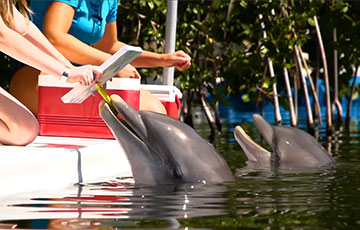
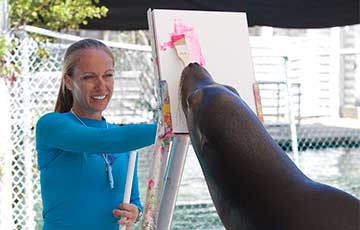
• Training at Theater of the Sea utilizes operant conditioning techniques based on positive reinforcement.  Basically, desired behavior is reinforced and undesired behavior is ignored. 
 
• New behaviors can be taught in a number of ways including targeting, where the animal remains in contact with a target object and is led through the movements of a behavior. 
 
• Behaviors are often shaped in stages called approximations, where a series of gradual steps build up to a final behavior. 
 
• The length or time it takes to train a behavior depends on the animal, the trainer, and the behavior. 
 
• Each trained behavior has a unique signal, such as a hand or verbal cue. 
 
• Another signal, such as a whistle or the word good, is called a bridge and indicates that a behavior has been performed correctly and will be reinforced. 
 
• A reinforcer is anything that increases the likelihood of the behavior, such as food or attention.
 
• Since any reaction to a behavior is potentially reinforcing, unwanted behavior is ignored.
 
• With training, behaviors the animals do naturally can be shaped into those performed for shows, programs, and medical procedures.

GOVERNMENT
In the United States, the Marine Mammal Protection Act of 1972 protects marine mammals both in human care and in the wild.
 
For a facility to display marine mammals federal permits are required and standards for the care and maintenance of the animals must be met.  Some of these standards include pool size, water quality, and fish storage and preparation.
 
In the wild, it is generally prohibited to hunt, harass, approach, swim with, or feed marine mammals. 
 
The dolphin seen on restaurant menus in the United States is a fish and is unrelated to the dolphin mammal.
 
CONSERVATION
Although protected in the U.S., marine mammals face many human imposed threats in the U.S. and around the world.
 
Marine debris can be ingested or entangle marine life.
 
Marine mammals are often killed in the name of cultural tradition. For example, every June in the Faeroe Islands, 3000 pilot whales are driven by boats into coves and slaughtered.
 
Exceptions to protection laws allow for native subsistence hunting of marine mammals. For example, the United States permits Native Americans to hunt a certain number of marine mammals.
 
Exceptions to protection laws allow for "incidental" deaths of marine mammals in fishing operations. Indiscriminate fishing techniques, such as drift nets, are used to meet consumer demand for fish, and kill everything in their path including non-target fish, sea turtles, sea birds, and marine mammals. These nets are often lost or discarded at sea, where they continue to kill.
 
The ocean’s resources cannot compete with modern fishing techniques and over fishing, which deplete the food source for marine mammals and all marine life.
 
As a result of over fishing, dolphins, sea lions, and other marine mammals are often used as scapegoats, blamed for declining fish populations. This results in intentional killing, often legal, of both individuals and populations.  For example, in Newfoundland, 300,000 harp seals are killed each year, blamed for declining codfish populations. And along the Japanese coastline, dolphins are driven into shallow bays with nets, then gaffed, and dragged ashore where they are killed.
 
INTERACTING WITH WILD MARINE MAMMALS
Normally, wild animals tend to keep a distance from people, but when people feed and interact with them, they can lose their natural fear of humans and become vulnerable to a variety of problems.  This is also why it may not be so easy to return animals from human care to the wild.
 
Marine mammals who are accustomed to being fed by people…
• spend unusual amounts of time near boats, have been struck by them, and cut by propellers.
• can learn to steal fish off fishing lines, ingesting monofilament line and hooks.
• have been fed inappropriate food such as poor quality/spoiled fish, beer, ice cream, or non-edible items.
• are at risk for encountering people who view them as nuisances.  The National Marine Fisheries Service have reports of marine mammals who have been shot, fed explosives, or injured by other means.
 
There are also risks for humans who attempt to interact with wild marine mammals.·       
• Any animal who feels threatened is capable of aggression.
• Animals who become moochers can get pushy and aggressive when they don’t get the handouts they have come to expect. 
 
 "WILL YOU EVER RELEASE YOUR DOLPHINS?"
No.  We would no more release one of our dolphins than you would abandon your dog in the woods. 
 
The return of an animal to the wild must be done in a manner that protects wild populations as well as the individual. Although the marine mammal community releases hundreds of stranded animals back to the wild each year, there are many issues with returning an animal to the wild who has been in long-term human care. These include:  
• disease transmission
• unwanted genetic exchange
• the ability of the released animal to adequately forage and defend himself
• most importantly, the fact that the animal has lost his natural fear of humans 
 
To quote the founder of Sea Shepherd, Paul Watson,..."The cry of "Free Willy!" is exciting and inspirational, but what does it really mean? Free Willy to an ocean where whales and dolphins are slaughtered in the hundreds of thousands? To an ocean stinking with pollutants-an ocean of abuse? ...If we don't halt the wanton killing in the wild, the only place dolphins will survive will be in captive facilities."

back to top

home